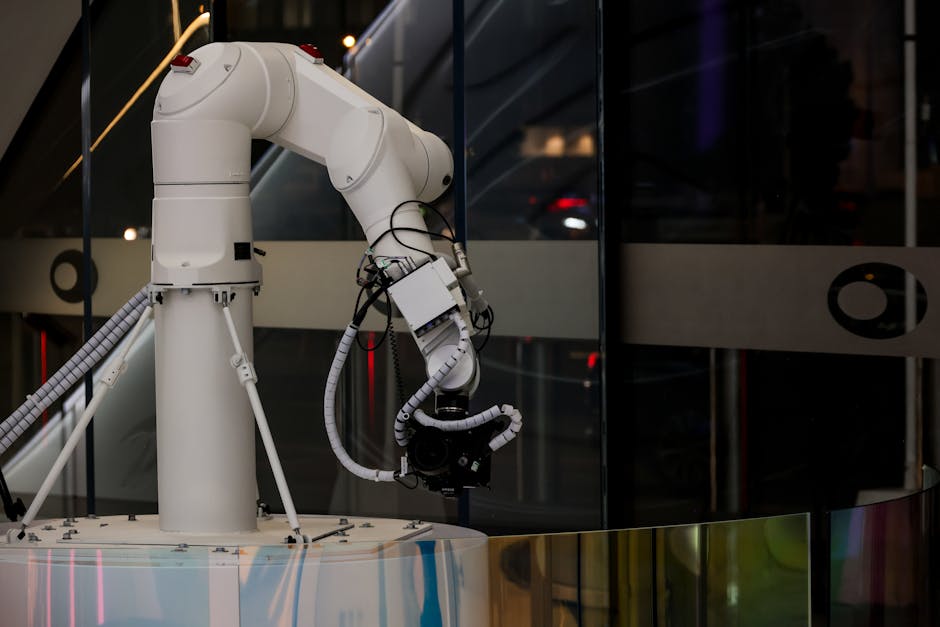
Have you ever worried about a production line grinding to a halt overnight, or inventory mismanagement causing delivery delays? Traditional manufacturing often felt like a constant battle against unpredictable variables. But with artificial intelligence (AI) deeply integrating into the sector, those concerns are rapidly becoming a thing of the past. As an AI Power User, I’ve had the privilege of witnessing firsthand how AI is transforming the manufacturing floor, and I’m excited to share my insights into the very real future of smart factories.
Unleashing Efficiency: Predictive Maintenance and AI-Driven Quality Control
One of the most impactful applications of AI I’ve observed in the field is **Predictive Maintenance**. Gone are the days of reactive repairs or time-based preventative schedules. AI analyzes real-time data from machinery – subtle vibrations, temperature fluctuations, sound patterns – to accurately predict when a component might fail. What does this mean for manufacturers? I’ve seen it lead to drastically reduced downtime and significant cost savings on maintenance, keeping operations smooth and efficient.
Another game-changer is **AI-powered Quality Control**. Human eyes, no matter how trained, can miss minuscule defects. AI vision systems, however, meticulously scan products, identifying even the slightest imperfections with unparalleled precision. Companies I’ve worked with have seen their defect rates plummet and customer satisfaction soar. It’s not just about faster inspection; it’s about AI identifying the root causes of defects and enabling continuous process improvement. How’s that for smart manufacturing?
Beyond the Factory Floor: Supply Chain Optimization and Worker Safety with AI
AI’s influence extends far beyond the four walls of the factory, profoundly impacting **Supply Chain Management**. By leveraging AI for market demand forecasting, inventory level optimization, and logistics route analysis, companies can achieve unparalleled efficiency across their entire supply chain. I’ve seen businesses navigate volatile market conditions with remarkable agility, reducing costs and improving responsiveness. Imagine anticipating raw material price swings or supply disruptions and adjusting production plans proactively – that’s the power of AI at work.
Crucially, AI is also significantly enhancing **Worker Safety**. AI-powered CCTV systems can detect workers entering hazardous zones or verify the correct use of safety equipment. Even more, AI robots are now undertaking repetitive and dangerous tasks, dramatically reducing industrial accidents. In one factory I visited, AI systems were integrated to automatically shut down power or send emergency alerts during critical incidents. AI isn’t just replacing human effort; it’s actively safeguarding human lives.
Deep Dive: The Evolving Role of Humans & A Critical Take on AI in Manufacturing
Many worry that AI will displace human jobs, but my ‘deep dive’ insight from the field tells a different story. AI’s introduction tends to automate mundane, repetitive tasks, freeing up skilled workers to focus on more creative, value-added activities. We’re seeing new roles emerge, such as data analysts and AI system operators/maintenance specialists. AI is a tool for transforming the nature of work, not simply replacing humans. It can actually be an opportunity to enhance worker skills and job satisfaction. We should embrace this shift.
However, a **critical perspective** is absolutely necessary. Implementing AI-driven smart factories often involves **substantial upfront investment**, and integrating these new systems with existing legacy infrastructure can be surprisingly complex. Furthermore, the **quality and potential bias of the data** used to train AI models directly impact their accuracy and reliability. A poorly trained AI could make inefficient decisions that lead to greater losses. We must not overlook the importance of robust data governance and ethical AI deployment. My advice? Don’t just implement AI; understand its limitations and proactively manage its risks.
The AI-Driven Horizon: A New Era for Manufacturing
AI-powered smart factories are no longer a distant vision; they are a tangible reality and a critical factor in determining a company’s competitiveness in an unpredictable global market. While the initial journey of adoption may present challenges, the long-term benefits in terms of productivity, efficiency, and safety are immense. I encourage businesses to view AI not just as a technology, but as a **strategic partner for innovation and growth**. I am confident that smart factories are the key to unlocking a new golden age for manufacturing.
#AI manufacturing #smart factory #predictive maintenance #quality control AI #supply chain optimization