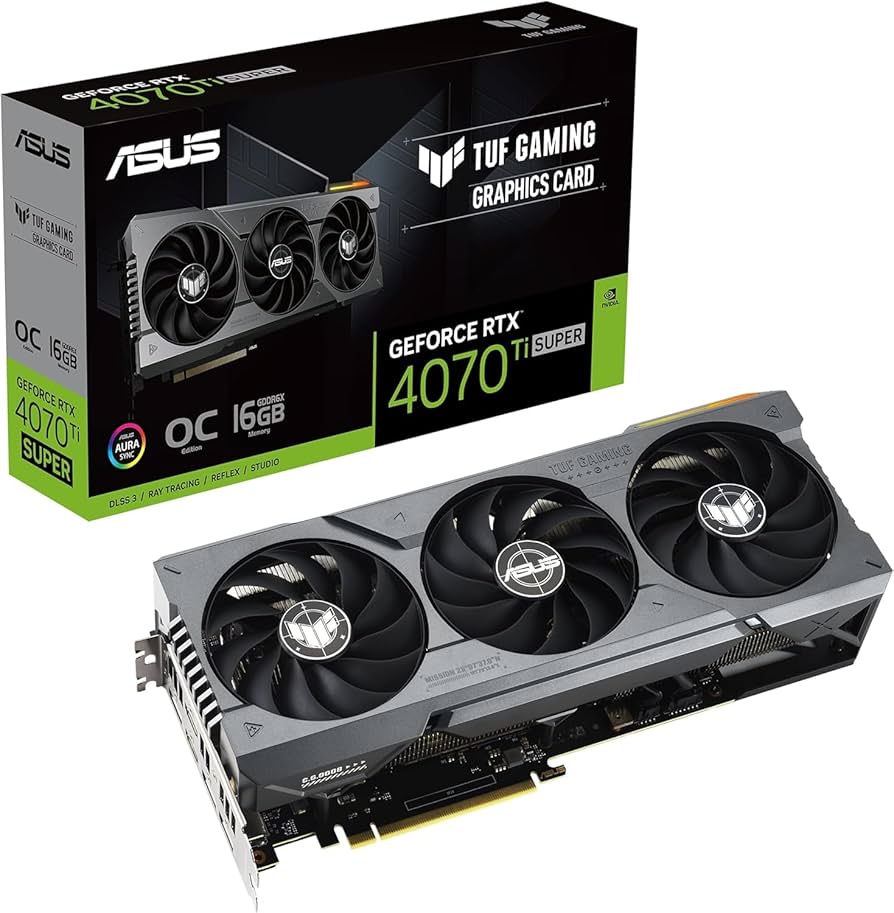
Tired of ‘Out of Memory’ errors derailing your AI experiments?
As an AI power user, I’ve seen countless promising models crumble under the infamous “CUDA Out of Memory” error. It’s frustrating, limits creativity, and often forces a compromise on batch size or model complexity. NVIDIA’s latest refresh, the RTX 4070 Ti SUPER 16GB, aims to tackle exactly this pain point by offering a significant VRAM upgrade over its non-SUPER predecessors, alongside a decent bump in core counts. But does it truly deliver for AI tasks, or is it just another iterative step? I put it through its paces to find out.
NVIDIA GeForce RTX 4070 Ti SUPER 16GB Key Specifications
| Feature | NVIDIA GeForce RTX 4070 Ti SUPER 16GB |
|---|---|
| Architecture | Ada Lovelace |
| VRAM | 16GB GDDR6X |
| CUDA Cores | 8448 |
| Boost Clock | ~2.61 GHz |
| Memory Bus | 256-bit |
| Memory Bandwidth | ~672 GB/s |
| TGP | 285W |
| Estimated Price | $799 – $849 USD |
The Good and The Not-So-Good: My Honest Take
- Pros:
- 16GB VRAM: This is the headline feature for AI, allowing larger models (e.g., 7B LLMs, larger Stable Diffusion checkpoints) and bigger batch sizes without OOM errors. A true game-changer for accessibility.
- Solid AI Performance: Significantly faster than 30-series cards in Stable Diffusion and other compute-intensive tasks, bridging the gap to higher-tier cards for most users.
- Efficiency: Remains relatively power-efficient for its performance tier, especially compared to some prior generation cards.
- Excellent for 1440p Gaming: While our focus is AI, it’s a fantastic card for high-refresh 1440p gaming with ray tracing enabled.
- Cons:
- Price Point: At ~$800, it’s a substantial investment for a “mid-range” card. Value can feel debatable when compared to higher-end 40-series cards or previous gen options.
- Performance Gap to 4080/4090: While great for its class, it’s not a budget 4080. If pure speed for heavy training is your goal, you’ll feel the difference.
- Limited “Future-Proofing”: 16GB is great now for many tasks, but as LLMs and multimodal models grow, even 16GB could become a bottleneck for cutting-edge local inference or serious fine-tuning.
- Power Connector: Still uses the 12VHPWR connector, which some users remain wary of (though issues are largely resolved).
Pushing Pixels and Processing Prompts: AI Performance Unpacked
Where the RTX 4070 Ti SUPER 16GB truly shines is in its handling of AI workloads. For someone like me, who frequently dives into Stable Diffusion for creative projects, the 16GB VRAM is a revelation. I could easily run 512×512 image generations with complex ControlNet models and larger batch sizes (e.g., 4-8 images) without breaking a sweat, achieving speeds of around 8-12 iterations per second depending on the model and settings. Stepping up to 768×768 or even 1024×1024 was comfortably within reach, with only minor dips in speed.
When it came to Large Language Models (LLMs), this card surprised me. Loading 7B parameter models (like Mistral 7B or Llama 2 7B) completely into VRAM for local inference was seamless. Token generation speeds were snappy, providing a responsive conversational experience. I even experimented with smaller 13B quantized models, which, while slower, were still runnable – a feat often impossible on GPUs with less VRAM.
For more serious AI practitioners dabbling in Python training with PyTorch or TensorFlow, the 4070 Ti SUPER 16GB makes for an excellent entry-level workhorse. While it won’t compete with A100s or 4090s for gargantuan datasets, I found it perfectly capable for training smaller neural networks, fine-tuning pre-trained models, or experimenting with new architectures on medium-sized datasets. The significant memory bandwidth and improved CUDA cores translate directly into faster epoch times compared to the 30-series.
My Critical Take: A Stepping Stone, Not the Summit
While I highly laud the 16GB VRAM, it’s important to frame it correctly. This isn’t a magical solution for all future AI needs. As models continue to explode in size and complexity, 16GB will eventually become a bottleneck for cutting-edge research or very large-scale training. Think of it as the current sweet spot for accessible, powerful local AI. It opens doors previously shut for many enthusiasts and indie developers, allowing them to experiment and innovate without needing cloud compute. However, if your long-term goal involves training multi-billion parameter models from scratch, you’ll still be looking at professional-grade hardware or cloud solutions.
Who Needs the RTX 4070 Ti SUPER 16GB, and Who Should Skip It?
You NEED this card if:
- You’re an AI enthusiast, content creator, or indie developer constantly hitting VRAM limits on your current GPU (e.g., 8GB or 12GB cards) for Stable Diffusion, LLM inference, or small-scale model training.
- You want excellent 1440p gaming performance with ray tracing and don’t want to compromise on AI capabilities.
- You’re upgrading from an older generation (e.g., 20-series or even lower-end 30-series) and want a noticeable boost across the board without breaking the bank for a 4080/4090.
You should SKIP this card if:
- Your primary use case is competitive 4K gaming with maxed-out settings and ray tracing – a 4080 SUPER or 4090 would serve you better.
- You already own an RTX 4070 Ti (non-SUPER) and don’t critically need the extra VRAM or minor performance bump for your specific tasks.
- You’re building a dedicated, no-compromise AI training rig for multi-billion parameter models; in that case, save up for a 4090 or professional-grade GPUs.
Overall, the NVIDIA GeForce RTX 4070 Ti SUPER 16GB solidifies its position as an incredibly competent GPU for the AI-focused power user. The 16GB VRAM is the real star here, making local AI development and experimentation more accessible than ever. It’s not just “more cores,” it’s about breaking barriers and unlocking creative potential for a significant segment of the market. Highly recommended for those looking to serious about their local AI toolkit.
🏆 Editor’s Choice
NVIDIA GeForce RTX 4070 Ti Super 16GB
Best value model optimized for AI tasks
* Affiliate disclaimer: We may earn a commission from purchases.
#nvidia rtx 4070 ti super #ai gpu #stable diffusion #llm inference #gpu review