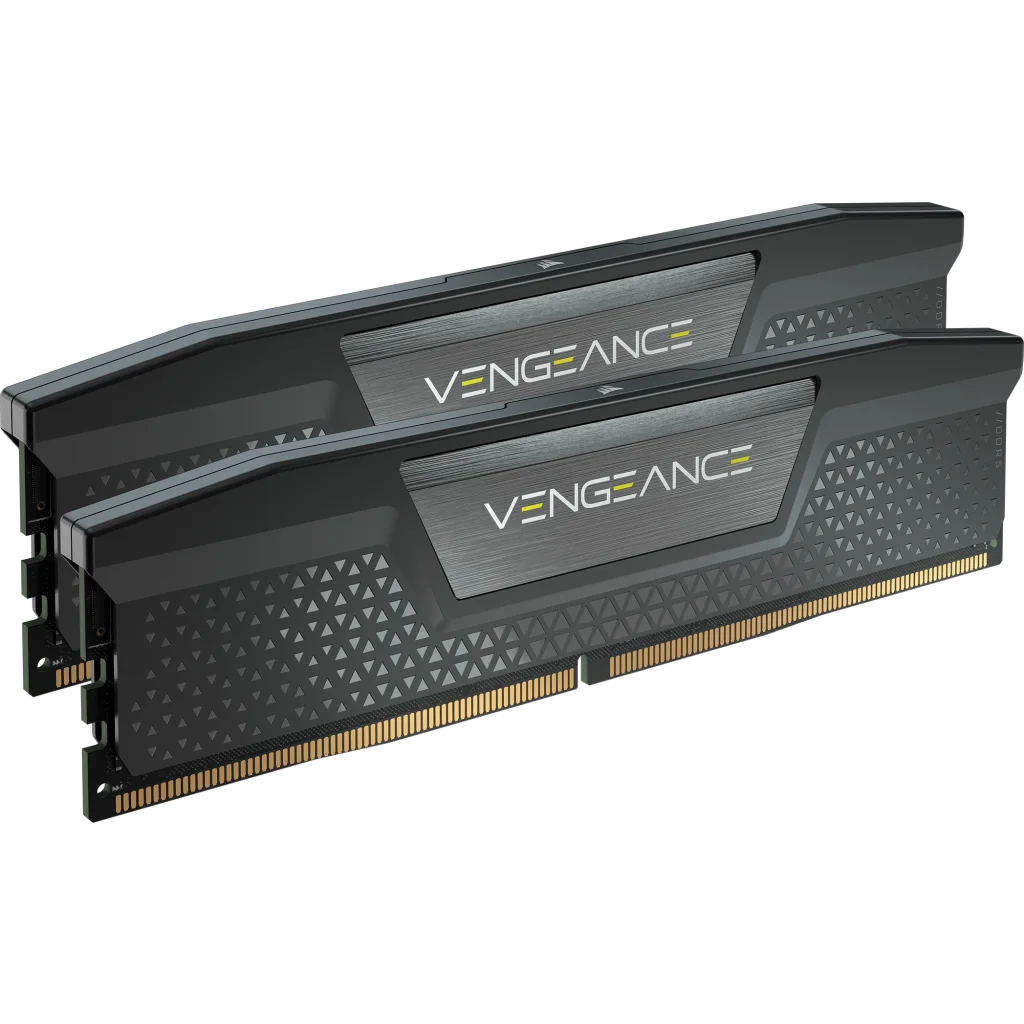
Ever found yourself staring at an infuriating ‘Out of Memory’ error when generating high-res images with Stable Diffusion, or pulling your hair out over sluggish token generation speeds from your local LLM? As a dedicated AI power user, these bottlenecks were a constant source of frustration. That’s why I decided to take the plunge and upgrade my system with the Corsair Vengeance 64GB (2x32GB) DDR5 RAM. Could this memory kit truly revolutionize my AI workflow and multitasking capabilities? Join me as I share my honest, in-depth experience and critical analysis.
✨ Corsair Vengeance 64GB DDR5: Key Specifications
| Feature | Detail |
|---|---|
| Capacity | 64GB (2 x 32GB) |
| Memory Type | DDR5 |
| Speed | Up to 6000MHz (XMP 3.0 Supported) |
| Latency (CL) | CL30-36 (Kit dependent) |
| Voltage | 1.35V-1.40V |
| Key Features | Robust Aluminum Heat Spreader, Intel XMP 3.0, Optimized PCB |
| Estimated Price | ~$200-250 USD |
👍 The Upsides: Why 64GB DDR5 Matters
- Unparalleled Capacity (64GB): This is the main event. For heavy multitasking, loading massive AI models (e.g., Llama 2 70B), or processing huge datasets, 64GB virtually eliminates ‘out of memory’ issues. I’ve been able to run more complex Stable Diffusion tasks with larger batch sizes without a hitch.
- DDR5 Performance Boost: While not always a game-changer for raw framerates, the increased bandwidth and lower latency of DDR5 significantly improve overall system responsiveness, especially in applications that are memory-intensive.
- Rock-Solid Stability: True to Corsair Vengeance’s reputation, this kit operated flawlessly even with XMP 3.0 enabled. The build quality and aluminum heat spreaders inspire confidence.
- Sleek, Subdued Aesthetics: The black aluminum heat spreaders look professional and blend seamlessly into almost any build.
👎 The Downsides: What to Consider Before Buying
- The Price Tag: Let’s be honest, 64GB DDR5 isn’t cheap. It’s a significant investment compared to 32GB DDR5 or any DDR4 kit. Is it always justified for your use case?
- Diminishing Returns for Some (Critical Take): While 64GB unlocks new possibilities for AI, the speed increase from, say, 5200MHz to 6000MHz in DDR5 might not drastically accelerate your GPU-bound AI computations. The capacity is the true hero here. If 32GB DDR5 is already preventing RAM bottlenecks for your specific AI tasks, the jump to 64GB might offer less tangible benefits relative to the cost. Don’t mistake capacity for magical speed if your GPU is the primary bottleneck.
- Motherboard Compatibility: You absolutely need a DDR5-compatible motherboard and CPU. Always check your motherboard’s QVL (Qualified Vendor List) to ensure full compatibility and stable XMP profile support at advertised speeds.
🔬 Deep Dive: Real-World Impact on AI Workloads
The moment I installed the Corsair Vengeance 64GB DDR5 RAM, I immediately turned my attention to its performance in AI-centric tasks. Here’s how it truly impacted my workflow compared to a 32GB setup:
- Stable Diffusion & High-Resolution Image Generation: Previously, generating multiple 1024×1024+ images with SDXL models or using several ControlNet pipelines often led to system RAM limitations, even if GPU VRAM was adequate. With 64GB, I can now effortlessly generate batches of 4-6 images at 1024×1536 resolution, or even experiment with higher resolutions and more complex prompts without fear of crashes or slowdowns. It’s not just more stable; it’s a significant boost in creative throughput.
- Local LLM Inference Speed: Running larger local LLMs (think 70B parameter models like Llama 2 or Mixtral 8x7B) demands substantial memory. This 64GB kit proved invaluable, especially when offloading portions of these models to RAM if GPU VRAM was constrained. While the GPU dictates raw token generation speed, faster model loading and reduced swapping (paging to disk) dramatically improved overall responsiveness and the ability to run more ambitious models locally.
- Python-based AI/ML Training & Data Preprocessing: When working with massive datasets in PyTorch or TensorFlow, insufficient RAM can turn data loading and preprocessing into a major bottleneck, leading to increased disk I/O and slower training epochs. The 64GB capacity ensures a fluid experience when handling millions of image files, or complex data augmentation pipelines. While it doesn’t directly speed up GPU compute, it removes a critical memory bottleneck, accelerating the overall training pipeline significantly.
In essence, the 64GB DDR5 RAM drastically expands the ‘scope’ of AI tasks I can perform and maximizes the ‘stability and efficiency’ of my existing AI workflows. It’s not just about a bigger number; it’s about providing a concrete solution for memory-intensive AI workloads.
🎯 The Verdict: Is This RAM For You?
The Corsair Vengeance 64GB (2x32GB) DDR5 RAM isn’t just for hardcore gamers; it’s a “mandatory upgrade” for anyone like myself who frequently works with large-scale AI models, high-resolution content creation, or demands an extreme multitasking environment. If you’re constantly battling “memory full” warnings, this RAM will undeniably elevate your computing experience.
However, if your primary use cases are casual browsing, light gaming, or typical office productivity, 32GB DDR5 or even a well-specced 16GB DDR4 kit might offer better value. The critical question to ask yourself is: “Am I genuinely being limited by my current RAM capacity in my demanding tasks?” If your answer is a resounding “Yes!”, then the Corsair Vengeance 64GB DDR5 RAM is an outstanding choice that will empower your AI journey.
Ready to experience top-tier performance and stability? Don’t hesitate. Your AI projects will thank you.
🏆 Editor’s Choice
Corsair Vengeance 64GB
Best value model optimized for AI tasks
* Affiliate disclaimer: We may earn a commission from purchases.
#Corsair Vengeance #DDR5 RAM #64GB RAM #AI Performance #PC Upgrade