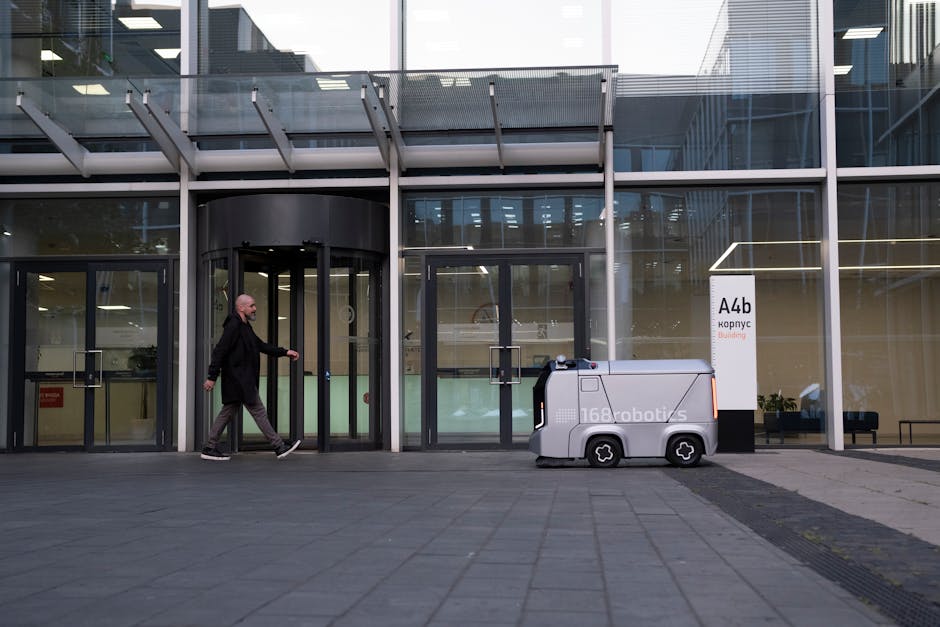
Hey there, fellow tech enthusiasts and productivity hackers! It’s me, your AI and digital productivity expert. Have you ever been stuck in rush hour, inching along, and wished your car could just take over completely so you could focus on something else, or better yet, just relax? I certainly have. Well, that futuristic dream might be closer than you think, with 2026 slated as a pivotal year for AI-powered autonomous driving technology.
The Road to 2026: A Paradigm Shift in Motion
I’ve been tracking AI’s rapid advancements for years, and few sectors are evolving as dramatically as autonomous vehicles. We’re moving beyond mere driver-assist features to systems where AI acts as the car’s eyes, ears, and brain, making complex decisions independently. Predictions suggest that by 2026, highly advanced Level 3 (conditional automation) and even some Level 4 (high automation under specific conditions) technologies will see more widespread commercial deployment. This isn’t just an upgrade; it’s a complete reimagining of our relationship with driving.
Unpacking AI’s Brain: A Deep Dive into Decision-Making
When most people think of self-driving cars, they imagine a vehicle moving on its own. But as an AI expert, I can tell you the real magic lies in AI’s predictive and decision-making capabilities. It’s not just about staying in a lane; AI fuses vast amounts of real-time data from an array of sensors—cameras, radar, lidar—and processes it through sophisticated deep learning models to ‘understand’ complex traffic scenarios. What truly fascinates me here is the continuous evolution of Reinforcement Learning (RL). The AI essentially learns by trial and error in countless simulated environments, refining its driving strategies to optimal levels. It’s akin to an experienced human driver honing their instincts over years. This advanced ‘learning mechanism’ of AI, which you won’t typically find detailed in official manuals, is what allows autonomous vehicles to adapt with increasing fluidity to unpredictable, real-world situations. I’ve personally witnessed the intricate decision-making processes in test environments, and it’s nothing short of remarkable.
What to Expect on Our Roads by 2026: Practical Scenarios
So, what will 2026 look like? I anticipate that in certain urban zones, we’ll see autonomous shuttles and robo-taxis becoming a more common sight. On highways, it might become routine to work, read, or even relax while your vehicle handles the driving. The logistics and delivery sectors are poised for significant transformation, with AI-driven trucks potentially handling long-haul routes overnight, maximizing efficiency. Imagine less stressful commutes and more productive travel time – debating what to have for dinner *inside* your self-driving car might soon be a reality, not just a sci-fi fantasy.
The Critical Take: Unseen Challenges and When Not to Trust AI Driving
However, it’s crucial not to get swept away by the hype. As an ‘AI power user,’ I believe in an unfiltered look at the challenges and practical limitations of applying this technology. First, the legal and regulatory frameworks are struggling to keep pace. Who’s liable in an accident? How will insurance adapt? These are massive, unresolved questions. Second, AI’s ability to perfectly anticipate unpredictable human behavior on the road is still a work in progress. The real world presents countless variables not yet fully captured in training data. Third, cybersecurity risks are significant; an autonomous vehicle is essentially a high-performance computer on wheels, making it a potential target for catastrophic hacks. Therefore, I must stress that I would not yet recommend full reliance on AI autonomous driving in extreme weather conditions like heavy snow or rain, or in highly complex, unmapped residential areas. In this ‘transitional phase,’ driver awareness and the ability to intervene remain paramount. It’s vital to remember that current technology excels under specific, controlled conditions, not all.
Are We Ready for an AI-Driven Future on the Road?
AI-powered autonomous driving undeniably holds immense potential to revolutionize our transportation experience, with 2026 marking a significant chapter in its evolution. Yet, it’s imperative that we acknowledge and proactively address the practical challenges alongside the technological marvels. I’m optimistic that through continued innovation, societal consensus, and robust safety protocols, this technology will mature healthily. What are your thoughts on the coming age of autonomous vehicles? Share your perspectives in the comments below!
#AI autonomous driving #self-driving cars #2026 AI forecast #future mobility #AI trends