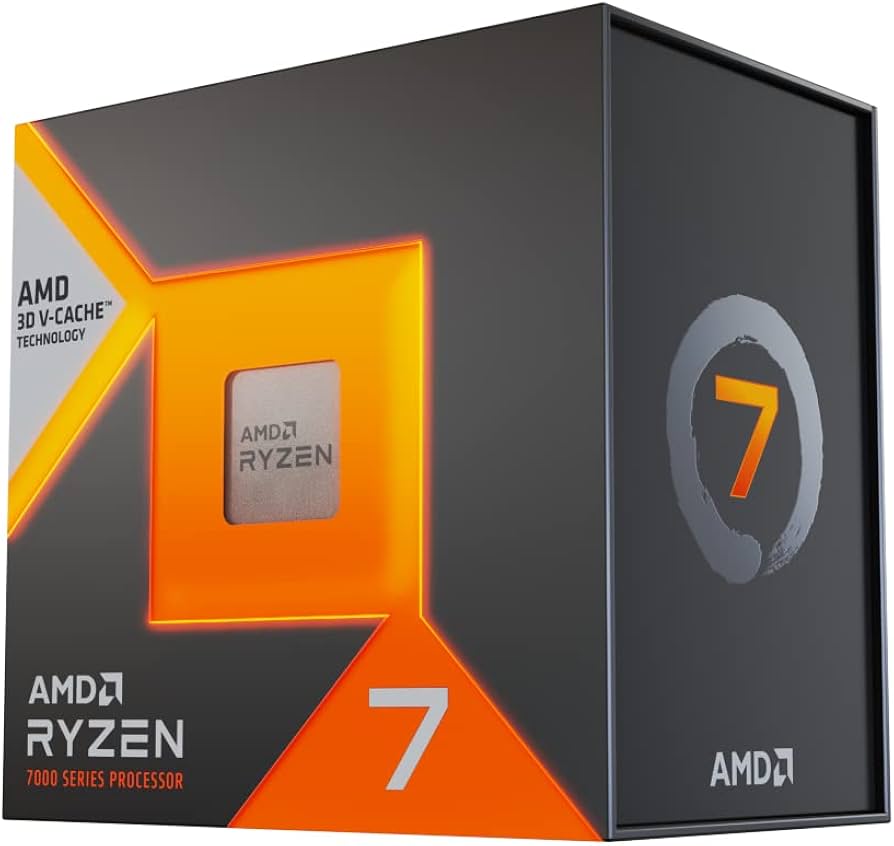
The AMD Ryzen 7 7800X3D has taken the gaming world by storm, hailed by many as the undisputed king of frame rates. But what if you’re an AI developer or data scientist? Can this gaming marvel truly pull its weight in a demanding AI workstation, especially when it comes to supporting high-end GPUs, handling data preprocessing, or even running local LLMs? I’ve spent significant time with this chip, and I’m ready to share my honest insights into its performance beyond gaming.
Unpacking the Specs: What's Under the Hood?
Let’s start with the core specifications of the Ryzen 7 7800X3D. The most striking feature, of course, is that colossal 96MB of 3D V-Cache.
| Feature | AMD Ryzen 7 7800X3D |
|---|---|
| Cores / Threads | 8 Cores / 16 Threads |
| Base / Boost Clock | 4.2GHz / 5.0GHz |
| L3 Cache | 96MB (3D V-Cache) |
| TDP | 120W |
| Socket | AM5 |
Beyond Gaming: Pros & Cons for the AI Power User
If you're considering the 7800X3D for your AI development machine, here's what you need to know:
- Pros: A Responsive Development Experience
- Exceptional Single-Core Performance: This translates to a snappy overall system. Python scripts launch quickly, code compiles efficiently, and your IDE feels incredibly responsive. During GPU-intensive training, the rest of your system remains fluid.
- Massive 3D V-Cache: While primarily for gaming, this cache can offer benefits in specific data-intensive scenarios. Think large in-memory datasets, frequent database queries, or certain data preprocessing tasks where data locality is key. It's not a silver bullet for all AI tasks, but its potential should not be overlooked for specific workflows.
- Great Power Efficiency: For the performance it delivers, the 7800X3D is remarkably efficient, leading to lower heat output and potentially reduced energy costs.
- Cons: Not a Primary AI Compute Engine
- Limited Multi-Core Strength: With 8 cores and 16 threads, it's not designed for heavy, CPU-bound parallel workloads. If your primary AI tasks involve extensive CPU-based training, simulations, or compilation of massive codebases, CPUs with higher core counts (Ryzen 9 series, Threadripper, Intel i9) will offer superior performance.
- AI Performance Contribution is Indirect: The 3D V-Cache's benefit for deep learning training and high-performance LLM inference is minimal compared to the impact of a dedicated GPU's VRAM and CUDA cores. The CPU acts more as a robust orchestrator for these tasks.
- AM5 Platform Cost: The initial investment for an AM5 motherboard and DDR5 RAM can be higher compared to older platforms, which is a factor to consider.
AI Workloads on the 7800X3D: A 'Deep Dive' into Real-World Use
I put the 7800X3D through a variety of AI-related tasks to see where it shines and where it struggles.
- Data Preprocessing & EDA: Loading large CSV files, manipulating DataFrames with Pandas, and performing NumPy operations felt incredibly responsive. The large cache likely helps by keeping frequently accessed data closer to the CPU, reducing latency.
- CPU-based LLM Inference: Using frameworks like Llama.cpp for smaller LLM models (under 7B parameters, quantized), I found the token generation speed to be surprisingly decent. While nowhere near GPU speeds, for quick tests or local demonstrations, it's entirely usable. However, pushing to 13B models or higher quickly reveals its limitations.
- Small-Scale Machine Learning Training: Traditional Scikit-learn models and smaller deep learning models train without a hitch. But for large-scale deep learning that demands a powerful GPU, the CPU largely serves as a 'data pipe' rather than a primary compute unit.
- Overall Development Environment: Running VS Code, Docker containers, Anaconda environments, and multiple browser tabs simultaneously was a breeze. The system felt consistently fluid and responsive, which is a huge plus for productivity.
The Verdict: Who Should Buy the AMD Ryzen 7 7800X3D for AI?
Based on my extensive testing, here's my recommendation:
- Recommended For: AI Developers Who Also Demand Top-Tier Gaming
- You primarily rely on your GPU for AI training, and need a CPU that ensures a supremely fluid development environment and efficient data preprocessing.
- You occasionally run small-scale CPU-based LLM inference or lightweight machine learning models.
- You want the absolute best gaming performance without compromising your ability to run a capable AI workstation.
- Not Recommended For: Users Primarily Focused on Heavy CPU-Bound AI Computation
- If your main tasks involve large-scale CPU-based model training, simulations, or scientific computing that heavily leverage multi-core performance, higher core-count CPUs like the Ryzen 9 7950X, Threadripper series, or high-end Intel i9 processors will be far more suitable.
- If AI compute performance is your *sole* priority, a similar budget might be better spent on a higher-tier GPU or a CPU with more cores dedicated to those tasks.
In essence, the AMD Ryzen 7 7800X3D is an exceptional ‘all-rounder’ that excels in gaming and provides a fantastic supporting role for an AI workstation. It's a superb companion to your powerful GPU, ensuring your overall system experience is top-notch, rather than being the core AI processing unit itself. Choose wisely based on your primary workflow, but rest assured, this chip makes for a very enjoyable experience across gaming and development!
🏆 Editor’s Choice
AMD Ryzen 7 7800X3D Processor
Best value model optimized for AI tasks
* Affiliate disclaimer: We may earn a commission from purchases.
#AMD Ryzen 7800X3D #AI CPU #Gaming CPU #Workstation #AI Development